Strategic Sales

A successful Go-to-Market strategy takes far more than a great product. Winning in new markets requires deep regional, economic and cultural insight - plus trusted local relationships that open doors, build credibility and accelerate traction.
This is where effective Sales Management becomes a true growth lever. It turns market knowledge into execution, connections into opportunities and strategy into predictable results. With the right structure, focus and leadership, Sales Management doesn’t just support your Go-to-Market- it drives it.
⇒ APILANi is your Alliance Partner for the successful execution of your international sales.
Key Account Management
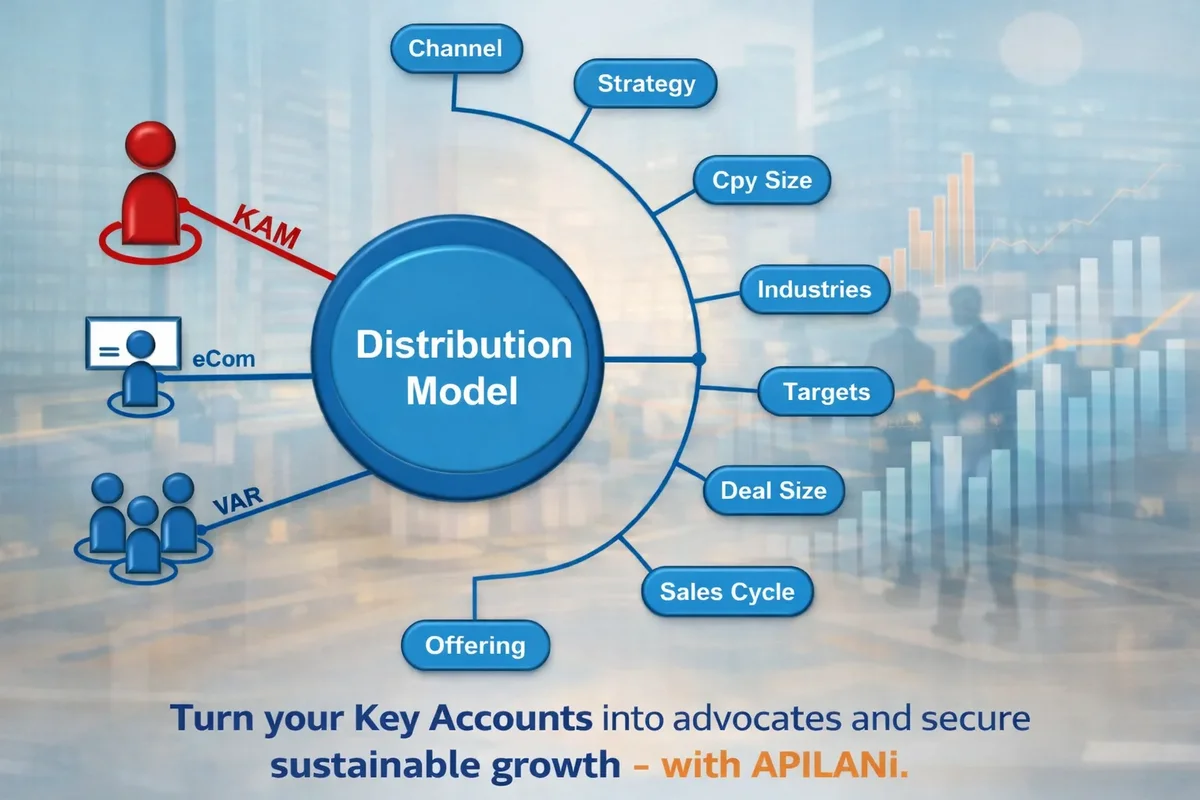
Strategic Key Account Management for Sustainable Growth
Turn your most important enterprise customers into long-term revenue engines.
In key markets such as DACH and across EMEA, APILANi’s senior Strategic and Key Account Managers build, manage, and grow high-value enterprise accounts with structure and focus. We don’t chase volume - we develop strategic customers that drive predictable growth. We take ownership of your key accounts, strengthen decision-maker relationships, and translate real customer needs into measurable revenue, stronger deals, and long-term market momentum.
What you gain:
✔️ predictable pipeline and revenue growth
✔️ stronger, C-level customer relationships
✔️ clear account strategies and execution
✔️ Product development aligned with real market demand
You gain strategic relationships with major Enterprise Customers as Key Accounts, directions for your further Product Development and long-term growth in different territories.
Partner Management

Partner Management becomes important when your products get more robust and standardized.
As part of your global Go-to-Market strategy APILANi then helps you to additionally generate Business indirectly through various Sales channels like VARs, IVSs, SIs, Affiliate Partners etc. We help you to bring your Business Partners up to speed to distribute your Product line more quickly within Europe.
Keep your business partners informed if you want to position your product line faster in EMEA. A better understanding of your customers' purchasing preferences and the strengths of your channel partners, accelerates the Sales Cycle.
In order to gain market share within Europe you need to manage your existing Channel as well as strategic Partners (OEMS, VADs, VARs, Service Providers). Marketing campaigns, customer-events are also all part of our well-elaborated Business Plan.
As part of your Go-to-Market concept you need to establish and expand your ISV and SI network.
You gain access to focussed Sales and Business Consulting Partners, experienced Value Add Channel Partners and a broad network of Systems Integrators.
Solution Selling
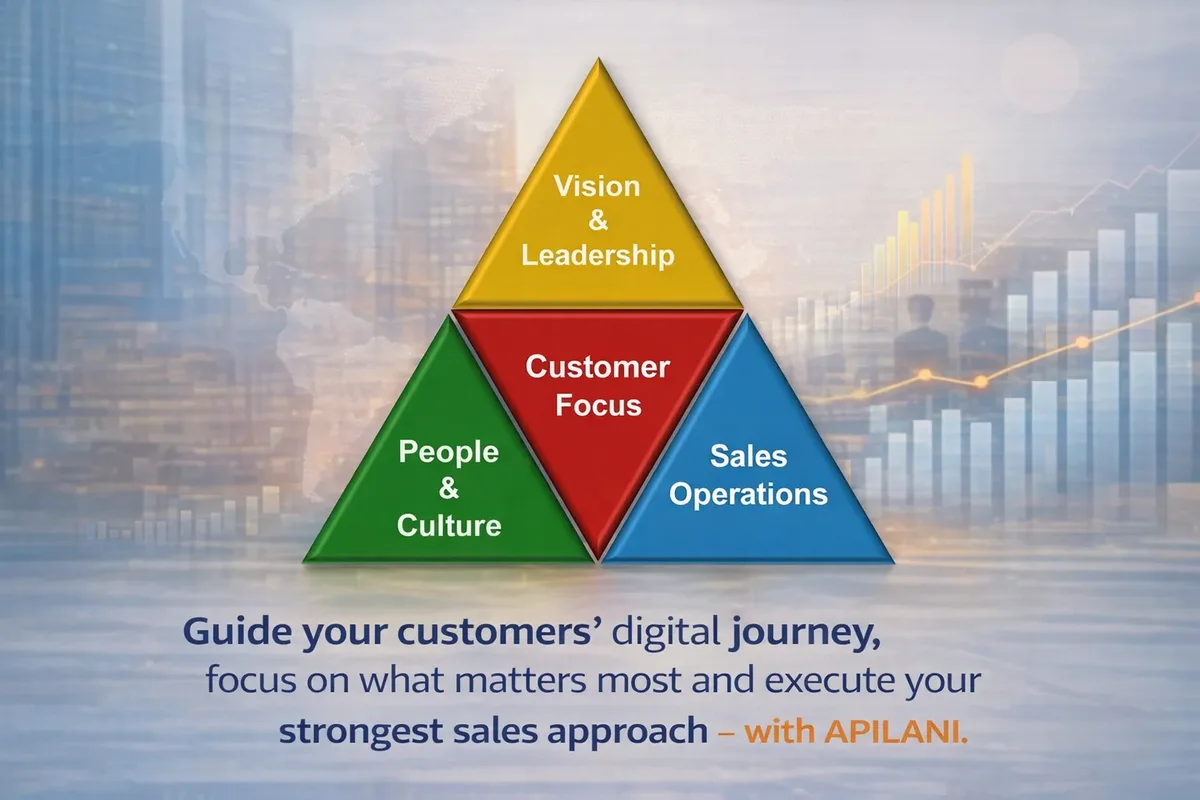
APILANi helps you focus on the customers and opportunities that truly matter. We support you in addressing high-potential accounts with the right strategic topics - such as infrastructure modernization, digital transformation and platform strategy - so your sales efforts are aligned with real business priorities, not just activity.
By structuring your target markets and segments, you gain the ability to set clear priorities and allocate the right resources where they create the highest impact. This enables you to deploy focused, account-driven sales approaches instead of spreading effort across low-impact opportunities - and to systematically increase win rates, deal quality and sales efficiency.
Solution Selling, combined with consulting-driven value creation, is a critical success factor for building a scalable and high-performance sales organization. It shifts sales from product pitching to business impact, from reactive selling to strategic engagement - and turns your sales team into a trusted advisor for your customers and a predictable growth engine for your business.
Win-Win for You and Your Customers
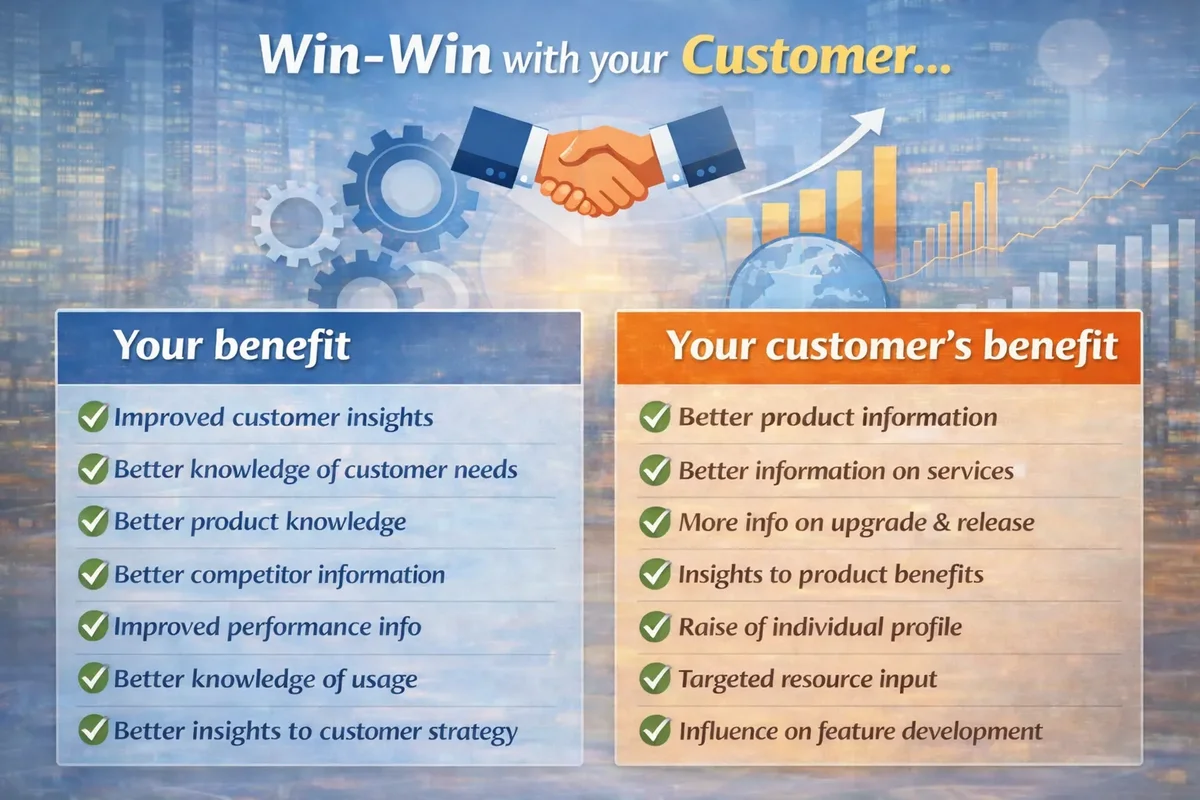
With a clear, data-driven approach, you create real value on both sides.
You gain deeper customer insights, develop a better understanding of needs and usage, and build strong product and competitive knowledge. This gives you more transparency, better decision-making, and a clearer view of your customers’ strategy - enabling more focused actions and stronger performance.
Your customers' benefits:
Your customers' benefits from clear product and service information, early insights into upgrades and releases, and a better understanding of product value. At the same time, they receive targeted support, can strengthen their individual profile and even influence product development.
The result:
A stronger partnership, better decisions and sustainable business success - for both sides.
✔️ APILANi helps you on direct and indirect Sales to complement your Sales Coverage. You get access to IT consulting experts to continuously grow your long-term relationships with your Enterprise Customers. 👉📧
Sales Operations & CVM

Professional Sales Operations are a key lever for sustainable growth and strategic control.
They create transparency, improve decision quality, and help you spot market shifts, customer needs, and demand trends early.
With the right setup, you
👉 anticipate demand instead of reacting to it
👉 make decisions based on reliable data
👉 scale your sales performance with focus and control
That’s how sales evolves from an operational function into a strategic leadership instrument.
At APILANi, we support you with tailored back-office services to build a structured, scalable, and Europe-wide consistent sales organization.
Together, we define clear sales objectives, roles & responsibilities, robust planning and steering models, and transparent reporting.
The result:
🎯 Full control over focus, priorities, and resources
📈 A foundation for predictable, profitable growth in your target markets
Move from CRM to CVM - gain Market Share and long-term Customer Relationships
Customer–Vendor relationships are complex.
In every customer organization, multiple stakeholders shape the decision.
Some push for your solution.
Some block it.
Some don’t even know you – but have already made up their minds.
Others follow a hidden agenda that never shows up in the official discussion.
If you don’t know who wants what – and why – you’re not managing your sales. You’re guessing.
⇒ That’s why a modern, up-to-date CRM is not optional. It’s the difference between random activity and predictable revenue.

CRM is more than a sales tool.
It’s not just an address book for sales teams – it’s the central nervous system of your customer relationships.
The real value of a CRM doesn’t lie in names, revenue figures, or contact details. It lies in the relationship: to your customer, to your competitors, to their market – and to the entire ecosystem.
This relationship intelligence isn’t only critical for Sales, but for Marketing, Service, Finance – and even for Product and Engineering teams.
That’s why one principle matters: Everyone works on one platform. With one shared truth.
Marketing campaigns start in the CRM.
Leads are created there, qualified there, and turned into opportunities.
Meetings, presentations, negotiations, quotes, invoices, and payments are linked directly to the deal.
Support, consulting, training, and up- & cross-selling all flow back into the same system.
⇒ This is how Customer Relationship Management evolves into Customer Value Management – and that’s what gives you a measurable, sustainable competitive advantage.
Important:
Success comes from clear ownership and real collaboration.
Leave tasks with the responsible teams – even when it’s hard. Customers notice the difference and value professional accountability.
There is no scapegoat in Sales or Support. Complex challenges don’t have simple villains.
It’s not “the others” who are the problem – the team approach is the solution.
Only together can complex challenges be mastered successfully and sustainably. 💪
Orchestration of responsibilities within the Sales Cycle
Marketing

- Marketing Campaigns
- Lead Generation
- Opportunity Creation
- Handover to Sales
Sales

- Work on Opportunity
- Sales Negotiation
- Work on Purchase
- Customer Care
Service & Support

- Product Delivery
- Accounting / Invoicing
- Operational Care
- Handover to Sales
Automated sales. Real competitive advantage. We turn Customer Value Management into action. 👉 Contact us!
✔️ With APILANi you get a powerful CVM Solution to guarantee sustainable customer retention. 👉📧
Sales Transformation

Changing customer organizations, evolving markets and shifting strategies on the customer side can have a massive impact on your go-to-market strategy - and, if left unmanaged, can quickly undermine even the strongest business initiatives.
In complex product and solution sales, you should be prepared for sales cycles of up to 12 months or more. These long cycles are not linear - they move through distinct phases, each requiring a different strategic focus, a different level of leadership involvement, tailored sales engagement and the right tool support at the right time.
That’s why successful Go-to-Market execution is not about pushing harder - it’s about steering smarter. By structuring the sales cycle into five clear phases, you gain control over priorities, improve decision-making, align stakeholders and systematically increase your chances of closing complex, high-value deals.
You want to optimally adapt to changing market conditions?
We accompany you on your journey to strategic Sales Transformation with concrete actions! 👉📧
✔ With APILANi you will become pro-active in selling to make your sales approach more effective. 👉📧
User Experience Management & Customer-Satisfaction
