Business Coaching & Mentoring

You are an IT vendor or IT startup and want to position your company, product, market access, or team in the right way? Then the most important first step is clarity. Before you invest time and budget into sales, marketing, or expansion, you need to understand what really matters, what comes first, and what will create impact.
To make the right decisions, you must be able to analyze, structure, and prioritize your challenges and opportunities. We help you break down complex situations into clear, manageable topics, identify dependencies, and define a logical sequence of actions. This turns uncertainty into focus—and ideas into an executable plan.
Instead of reacting to market pressure or following generic playbooks, you gain a strategic perspective on your positioning, your go-to-market approach, and your organizational setup. You will know which problems to solve first, which initiatives deserve priority, and where your resources will generate the highest return.
APILANi is your Alliance Partner for opening up new options in positioning, market access, and growth. We don’t just give advice—we work with you to create clarity, sharpen your strategy, and translate it into concrete next steps. The result is a focused roadmap that enables you to move forward with confidence, speed, and purpose.
⇒ APILANi is your Alliance Partner for new options for your positioning.
Situation Analysis
Situation Analysis
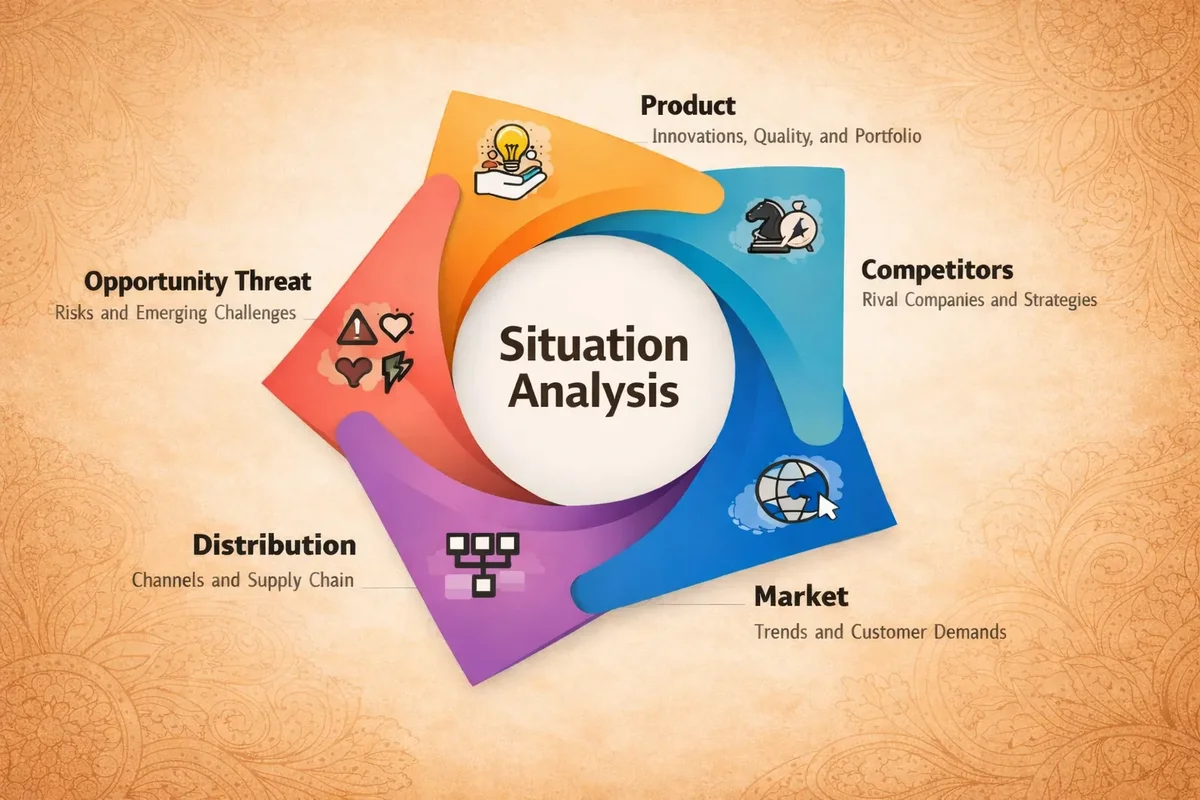
Strategic Implications- key insights that directly support decision-making:
📌 critical success factors (e.g., digital readiness, talent, security)
📌 urgent risks or gaps requiring attention
📌 investment priorities (where to allocate resources)
📌 change enablers (culture, leadership, tools)
We provide you with a clear, data-driven view of your current situation as a solid foundation for strategic and IT-related decisions.
Together, we analyze your status quo and develop a practical roadmap for a sustainable overall solution. You can structure, prioritize, and validate your actions and focus exactly where the greatest impact lies—from the most critical issues down to the details.
With our systemic approach, you gain transparency into dependencies, reduce complexity, and uncover new courses of action that were previously not visible or within reach.
Internal Environment: Focus: What’s happening inside the organization.
| Area | Key Points to Assess | Decision Relevance |
|---|---|---|
| 1. Resources & Capabilities | ➜ Financials, human capital, technical assets, infrastructure | 📌 determines feasibility and investment priorities |
| 2. Processes & Efficiency | ➜ Workflow effectiveness, automation level, bottlenecks | 📌 identifies optimization or digitalization opportunities |
| 3. Technology Landscape | ➜ Existing IT systems, compatibility, security posture | 📌 guides upgrade or replacement decisions |
| 4.Culture & Leadership | ➜ Innovation readiness, collaboration, change acceptance | 📌 influences implementation success and transformation strategy |
| 5. Performance Metrics | ➜ KPIs, ROI, productivity indicators | 📌 provides baseline for measuring impact of decisions |
External Environment: Focus: What’s happening outside the organization.
| Area | Key Points to Assess | Decision Relevance |
|---|---|---|
| 1. Market & Industry Trends | ➜ Growth areas, new technologies, digital transformation trends | 📌 helps anticipate change and identify opportunities |
| 2. Customer Expectations | ➜ Needs, satisfaction, digital experience preferences | 📌 drives prioritization of customer-centric initiatives |
| 3. Competition | ➜ Competitor strategies, innovation pace, benchmark data | 📌 informs differentiation and positioning |
| 4. Regulatory Environment | ➜ Compliance, data protection, ESG requirements | 📌 avoids legal/operational risk |
| 5. Partner Ecosystem | ➜ Suppliers, alliances, outsourcing landscape | 📌 affects operational stability and scalability |
Questions for Success
► Is our product right for the Market?
► Is there a Market already or are we probably too early?
► Are we right in time with our product or should we wait and add specific functionality first?
► What makes us the right team?
► Are we doing what we can do best?
► Do we as a team complement each other or do we compete?
► How can we grow best?
As a result of the Situation Analysis Process you can now structure your topics, know about the influences and interactions, validate the objectives and immediately understand which are the right actions to take.
⇒ You will have a list of action items to be solved for each identified topic - already validated according to priority, effectiveness and dependency.
After the Situation Analysis Session you have a clear focus on how to improve your current situation or challenge. You are able to generate a structured guideline including all necessary steps.
⇒ You know about the influences and interactions of different groups associated like customers, competitors, investors, employees, families, friends etc. and can adjust their action to obtain the best result possible.
Target Management
Target Management

After the Situation Analysis, you gain clarity about where you really stand and what truly matters for your business. You can structure your topics with confidence, understand the key influences and interactions, and validate your objectives based on facts instead of assumptions.
Rather than relying on gut feeling or fragmented information, you get a holistic view of your current situation. This makes it easy to identify what is strategically relevant, where risks are emerging, and which opportunities are worth pursuing. You immediately see which initiatives create real impact—and which ones only consume time and resources.
With this foundation, you can prioritize effectively and align your teams around a shared understanding of goals and challenges. Decisions become faster, more focused, and more reliable, because they are grounded in a structured and transparent analysis.
The result is a clear actionable roadmap: you don’t just understand the situation—you know exactly which actions to take and why. This enables you to move from analysis to execution without delay and to act immediately with confidence and purpose.